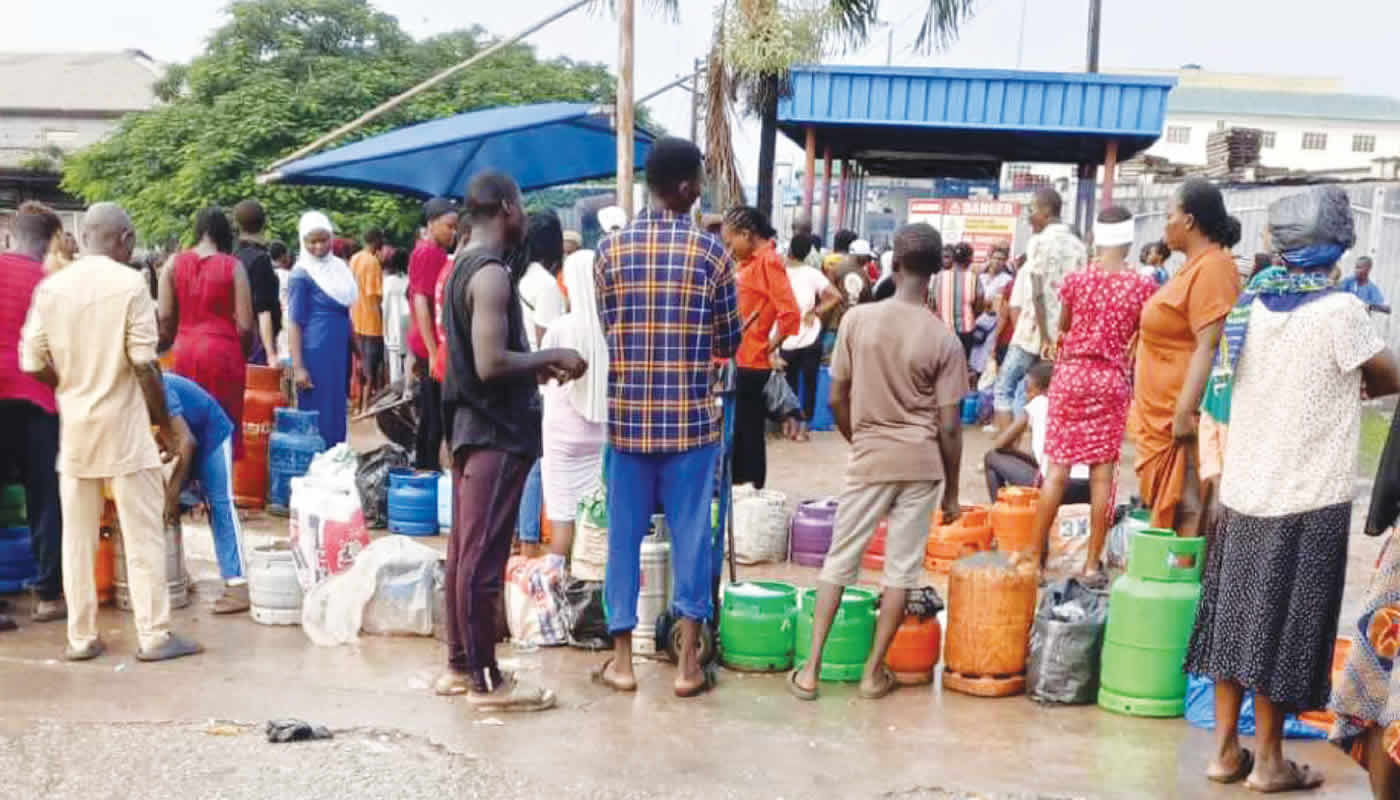
Nigeria’s deepening cost-of-living crisis is pushing households and small businesses away from cooking gas, as soaring Liquefied Petroleum Gas (LPG) prices across major cities including Abuja and Lagos make refills increasingly unaffordable.
Market surveys indicate that cooking gas now retails at as high as N2,000 per kilogram in several parts of Abuja and Lagos— a significant jump from approximately N1,200 per kilogram recorded earlier in the year.
The surge means that filling a 12.5kg cylinder can now set consumers back as much as N25,000.
Businesses Count the Cost
For many food vendors and small-scale entrepreneurs, the numbers no longer add up. Mrs Mayo Akinpelu, a food seller in Gwarimpa, said she was left with little choice but to abandon gas altogether.
“Refilling my gas cylinder became difficult because the price kept rising. I could no longer afford it and still make a reasonable profit,” she said.
She acknowledged that switching to charcoal and firewood comes with its inconveniences, but noted the alternatives have kept her business afloat.
In Kubwa, business owner Grace Oluwatimilehin said she was caught off guard when prices shifted sharply.
Having watched the price climb from N1,600 to N2,000 per kilogram in a short span, she now supplements her cooking with electric hot plates and charcoal to manage costs.
Another food seller in Dutse, Bwari Area Council, Victory Samson, said the price surge has eaten deeply into her earnings and called on the government to step in.
Households Under Strain
Ordinary residents say the gas price increases are compounding financial pressures already driven by inflation and rising food costs.
Abike Ojo, a mother of one, said the difference between her last two refills was stark.
“The last time I bought gas, it was N1,500 per kg, but my latest refill cost N2,000. If it keeps rising, I may stop using gas entirely,” she said.
Across the board, consumers are urging the government to take immediate action to stabilise LPG prices.
Dealers Confirm Falling Demand
Gas vendors across Abuja say the drop in patronage is visible and growing. A dealer in Kubwa, Bamishile Bolanle, pointed to product scarcity and weakened purchasing power as the key drivers behind the price hikes.
In Dei-Dei, fellow dealer Alfred Orshio said the steady climb in prices has made large refills a luxury few can afford. “I cannot blame customers for buying less. Filling a 12kg cylinder now costs about N25,000,” he said.
Charcoal and Firewood See a Surge
As Nigerians move away from gas, alternative fuel sellers are reaping the benefit. Amina Yakubu, a charcoal distributor in Kubwa, said demand has grown sharply in recent weeks.
Another seller, Saratu Ibrahim, noted that stock that previously took over a week to clear is now selling out within two days.
Firewood traders are seeing similar trends. Seller Taninu Ibrahim confirmed that rising demand has also pushed up his prices.
“Before now, customers got six pieces of firewood for N1,000. Today, the same amount buys only four pieces,” he said.
Stakeholders are warning that without urgent intervention to address supply constraints and pricing instability, the shift away from cooking gas will continue — raising serious questions about energy affordability and environmental sustainability in the country.