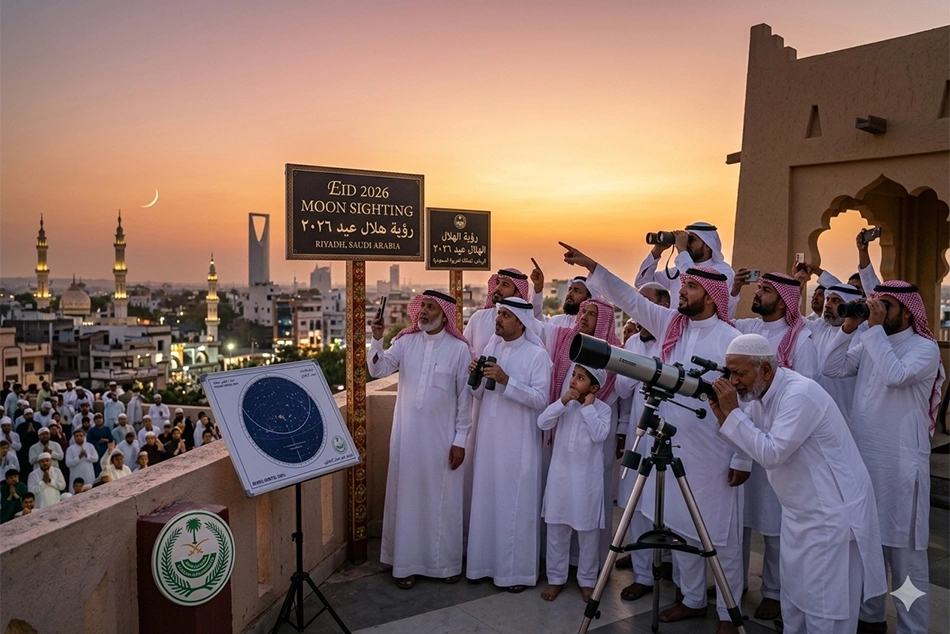
Authorities in Saudi Arabia have suggested that observing the crescent moon marking the end of Ramadan could be challenging due to unfavourable weather conditions affecting key observation points.
Reports from major observatories indicate reduced visibility.
Officials at Al-Hariq Observatory noted that current conditions are not ideal, while Sudair Observatory also confirmed the presence of cloudy skies, both of which may hinder efforts to sight the Shawwal crescent.
“The weather is not clear at the moment, and the sighting of the Eid crescent may be difficult,” Al-Hariq Observatory said.
Despite these challenges, monitoring activities have already begun at Dammam Observatory, which is among the earliest locations to commence the moon sighting process.
This situation has created some uncertainty regarding the official confirmation of Eid al-Fitr, as the celebration is traditionally determined by the successful sighting of the crescent moon.
In a subsequent development, authorities in Saudi Arabia have announced that the crescent moon indicating the beginning of Shawwal was not seen today, March 18 2026, meaning the holy month of Ramadan will run its full course.
With this outcome, Ramadan fasting will extend to 30 days, and the celebration of Eid al-Fitr is now set to take place on Friday across the Kingdom.
Confirming the update, Haramain stated on X:
“The Crescent of month of Shawwal 1447 was NOT SIGHTED anywhere in the Kingdom today, subsequently the month of Ramadan will complete 30 days tomorrow and Eid Al Fitr will be on Friday,”